A Pretty Blonde Girl with Bright Blue Eyes
I became friends with Betsy Jacobs the summer of 1980 on a Sunday afternoon, at a church picnic held at the local park, when I was sixteen and she was fourteen. Betsy was a pretty blonde girl with bright blue eyes, and one I’d certainly noticed, but I’d never talked to her much before that day when we spent most of the picnic together. She called me a few days later to ask me about some problems she was having with a boy and I asked her about things confusing me with a girl and that call set the pattern for our friendship over the next two years.
In the fall of 1982, I was hopelessly hung up on this long-distance relationship I was in with a girl named Barbara who I was sure I loved. I’d often talk to Betsy about her and our various problems and she’d always help me out. She was my best friend then and I always felt better just hearing her voice.
That December, I was hanging out with my friend Dan one day and wound up at the home of his girlfriend, Kira. Kira and Betsy were good friends and the four of us had recently performed together, singing and playing guitar, at an event at our high school.
Sitting in Kira’s living room, the fire going, she got up off the couch and put a record on the stereo. A slow love song came on and I sat slumped in the black vinyl chair staring at the fire and listening.
I was thinking about Barbara or, rather, I was trying to think about Barbara. It was a sensation sort of like when you’re at a show and you’re trying to see the stage or screen but there’s someone in your way and, no matter how you shift from side to side, you just can’t see around them. My head began to feel tight, as though some metal clamps had sprung suddenly around my skull, and I couldn’t understand what I was feeling. I had the sensation that I should be thinking of Barbara but I wasn’t. I was thinking of someone else. I was thinking of Betsy.
And that was when it hit me and I heard myself say in my head, “I’m not in love with Barbara. I’m in love with Betsy Jacobs!” I literally shot up out of the chair as though shocked and stood staring around the room stupidly as the song played on. Dan and Kira both looked at me and Dan said, “What? You ok?” Kira laughed a little nervously.
I wanted to say something but I didn’t know what to say and, really, thought I was going to faint, so I dropped down into the chair, shook my head, and then stood up again, then sat, and then said, “I don’t know. I just don’t know. What? Did you say something?”
Dan and Kira were both laughing at me now and I shook my head quickly and said, “I have to go home. I have to call Betsy.”
Kira said, “Oh, cool. You want to all go to a movie? We can see the new Pink Panther film. It’s at the Juliet.”
And I was so grateful to that girl just then because I’d realized, right after I’d said I had to call her, that I had no idea what I was going to say to Betsy when she answered the phone. I couldn’t very well just call the girl up and say, “Hi. I just realized I’m in love with you. Hope you feel the same!” Inviting her to a movie, though, seemed a lot more reasonable – and safer.
Dan dropped me back at my house and, heart pounding, I walked to the kitchen and lifted the receiver of the phone – then hung it up quickly. I stood and stared at the telephone and thought how absolutely crazy this feeling was. I had called Betsy hundreds of times and I had never felt this way before. My palms were sweating and my mouth was dry and my heart was pounding inside my chest so loudly it seemed to be echoing in the room.
What if she didn’t like me the same way? What if I told her I loved her and it just ruined our great friendship? What was I thinking standing there about to make the biggest mistake of my life? But – I realized – I didn’t have to tell her; I was just inviting her to a movie.
And so I wet my lips, took a deep breath, and dialed her number.
That was thirty-five years ago.
At the theater that night we held hands all through the show which, of course, we had never done before as friends. I didn’t tell her I was in love with her then. I thought I’d sort of `ease’ into telling her. The next day I wrote her a letter in which I didn’t tell her either and the day after that I wrote her another just like it and so on. It was over a month after my almost-fainting moment that I actually said the words `I love you’ to her and, by that time, she’d pretty much gotten the idea and, lucky for me, felt the same.

After high school, we went away to separate colleges and on her 20th birthday I surprised her by taking a bus up to visit. I had to skip three days of classes to make the trip but I didn’t care. I had told her I would be calling her on her birthday around four o’clock and once I landed in town I waited in a McDonald’s gazing up at the clock above the counter. Finally, I walked out and found a phone booth outside a store right next to where she lived in the dorms. When she answered the phone, she sounded sad.
“I miss you,” she said. “I wish you were here.”
“And, on your birthday, you should get what you wish for. I’m standing in a phone booth outside of Sugarman’s.”
“Well, what are you doing over there?” she asked. “Get over here.”
We hadn’t seen each other in months and it was so wonderful to hold her again as we hugged in the parking lot.
She asked me, “But aren’t you missing too many classes being here?”
“Twenty years from now,” I said. “When we’re married, I doubt we’ll remember what we learned in class this week. But we’ll always remember when I took the bus to surprise you on your twentieth birthday.”
We got married after college in 1987 and, all these years later, I was right. I remember the bus ride, the phone call, and the beginning of it all the night I almost fainted in Kira’s living room. And I remember the thousand things we’ve done together since that night and the thousand smiles she’s given me and I am forever grateful for each phone call and for every moment I’ve been able to spend being in love with my best friend, the pretty blonde girl with bright blue eyes.
END
A Cat of My Own (previously published in Chicken Soup for the Soul Anthology on Cats)
When I was a kid my house was a cat magnet. My parents were both well known in the community and so were their passions; among which was animal rescue. They were always adopting animals from the local shelter and bringing home strays of all types. At one point we had six dogs, thirteen cats, an aquarium of lab rats saved from euthanasia, wild birds whose wings had broken (separated from the cat community in their own room), lizards, homeless turtles, mice, two horses, and even a goat. This might all have been fine if we lived on a farm but we didn’t. We had a large house – a grand old 19th century home which had once served as General Store, doctor’s office, post office, and feed depot – but even a house that large could feel small with the ever-growing menagerie of animals. Whenever someone in the neighborhood – or even the wider community – found a stray cat or dog they knew it would find a home if they just dropped it off on the front porch of Raphael and Frances Mark.
I tell my daughter Emily these stories and she thinks it sounds like a wonderful paradise but it wasn’t always a lot of fun. I came to actually hate the cats because they were the most persistent presence. I’d open a kitchen cabinet in the morning for a bowl or plate and there was a cat in there looking down at me. Going to sit down at the dining room table I’d have to remove a cat from the chair – sometimes two. Cats on top of the TV, on the couches, on top of the refrigerator, on the stairs, under the coat rack, on the radiators; they were everywhere like some awful vermin. A friend of mine (and cat lover), Betsy Jacobs, told me my problem wasn’t the number of cats but that I just hadn’t found my own; I had no idea what she meant.
One New Year’s Eve, we all came back from dinner out to find the latest surprise on the front porch: a large black cat with enormous golden eyes and red ribbon tied around his neck. He was in pretty poor shape, his coat worn and dirty, and his tail was broken, twitching back and forth at an odd angle like some misshapen shepherd’s crook. Of course, there was no question what would happen next and my mother went to pick him up and bring him inside but he wasn’t having it. He backed away, hissing and growling, into a corner of the porch. The last thing I wanted was another cat but I did want to help Ma and so got down on the cat’s level and talked to him until he walked toward me and I picked him up. I carried him inside and got him some food and he calmed down a bit until my brother Jason sat down near him; then he attacked. He grabbed at Jace’s hand, scratched furiously, and then shot under a bureau in the dining room where he glowered and hissed at us. Jace said, “That thing’s like an assassin. You ought to name him Carlos” referring to a villain in a novel that was popular at the time. The name stuck; and the cat stuck to me.

Since I was the only one who could handle him without being mauled, he wound up in my room and became my cat. He wasn’t like the other cats in the house. He would entertain by leaping from the top of my bookshelf to the top of my open door and do a little tightrope walk across it, back and forth, before hopping down. He was a great nuzzler and loved to sit on my lap while I read. Every night he’d jump up on the bed when it was time to sleep and, if I stayed too long at my desk working on something, he’d hop up and knock my pen away to let me know it was getting late.
He was also an uncanny judge of people. He warmed up to Jace finally but I learned to trust his judgments about new friends I’d have over; if Carlos liked them, they were worth the time and, if he didn’t, they usually wound up being a huge mistake. He liked most of my friends but was especially fond of Betsy. Carlos lived a life of luxury there in my room and wasn’t inclined to exert himself very often but he always got up when Betsy visited, hopped onto this little table at the end of my bed for her to pet, and sometimes even climbed up on her shoulder. I knew I liked Betsy even without Carlos’ approval but it was still nice to have it.
Carlos liked Betsy so much that, when I got a letter from her, he would purr and sit in my lap while I read it; if I got a letter from anyone else, he either wouldn’t come near or, sometimes, would slap at it. If he didn’t like someone, he wasn’t at all shy about showing it by allowing them to come near and then latching himself onto their hand, biting and scratching but, when someone met with his approval, he was the sweetest gentleman and most caring friend. When I was sick with mono this one time, he wouldn’t leave me, not even to eat or drink, and when I’d come home from school at the end of the day, he’d jump off the bed and trot over to greet me at the door. He liked it even better when I’d come home with Betsy and he’d climb up on her shoulder and nuzzle her ear.
She said one time, “See? I told you. You just had to find your own cat” and I realized she was right. Without even knowing I was doing it, I’d been much kinder and more affectionate with the brood of cats around the house. Getting to know Carlos allowed me to recognize the personalities of the other cats. They weren’t just obstacles to sitting, walking, or eating anymore; Sam favored the top of the refrigerator because it was warm, Dwarfy liked laps because she was a people-cat, Mama liked the radiator in the downstairs hall because no one bothered her there.
Carlos was especially pleased when Betsy and I started dating and she spent even more time at the house. If I tried playing a board game with anyone else in my room the cat would walk all over it and actually kick the pieces; when Betsy came, though, he just curled up between us and watched until he became bored and fell asleep. Carlos opened the world of cats up for me and showed me how fascinating, warm, and wonderful they can be. He was long gone by the time Betsy and I got married but he lived on in the first gift I gave her in our first apartment: a small, black kitten.
END
The Boots that Saved my Life (Previously published in Chicken Soup for the Soul Anthology)
I’ve never hunted and never been interested in the sport but my friend, Matt, became a devoted hunter. Matt and I were college friends; he lived in the New York City area and I lived in upstate New York and he would often come stay with me to hunt in the woods around my house. On the days he hunted he would be up and out well before dawn and would leave me a note of where he was heading – longitude and latitude – and where and when he expected to emerge from the woods. My job was to find him there and bring him back to my place. This routine worked well every time and I liked the challenge of working from numbers on a map to pinpoint where I’d find him, reading whatever book I had until I heard the snap of a twig under his boot.
He called me this one time, though, and said he’d be bringing along his friend Kevin. I knew Kevin and liked him – he was a great guy – but as soon as I heard Matt’s voice on the phone telling me this, I felt uneasy. I had no idea why I should feel that way. Matt asked if I could meet them at a certain spot – longitude and latitude – some distance from my place and pick them both up to drive them back to their hotel. I agreed but, even as I did, I felt an odd tightening in the pit of my stomach.
The day of the hunt I went about my usual business and then got into my old clothes for hiking, including my old boots. I was just about to leave, my hand on the doorknob, when I felt the very strong – and strange – sensation that I should change my boots. I’m not big on fashion and don’t spend much time thinking about what to wear and so couldn’t understand why I would be feeling this way. My wife, Betsy, had recently bought me a new pair for work – not for stomping around fields or woods – and the ones I was wearing were my traditional go-find-Matt boots. There was no reason to change my boots but, when tried to shake the feeling off and leave the house, the sensation was so strong I couldn’t resist it.
New boots on, I drove the forty minutes to the area I’d calculated they would be and pulled in by the tree line off on a back road. I grabbed my book and walked down the road, consciously keeping from the sides where my boots might scuff on rocks. Scanning for a suitable reading spot, I noticed a green hill and wandered over there. This hill overlooked a ravine lined with stones of various sizes and shapes. The sun was dropping down low and the small valley was illuminated with a bright orange glow which sparkled among the large granite and smaller quartz far below me. Looking around, I figured this was pretty much the perfect spot since they would see me on the hill from whatever direction they came. I sat down and read my book.
It wasn’t long before I heard a shout and saw them coming down the road. They weren’t carrying any deer or any other game, just their rifles. I called out, “No luck?” and Matt shrugged and smiled but Kevin was clearly angry and greeted me shouting, “Nothing! Out all day and – Nothing!” Matt just shrugged again, saying, “Next time” and we all sat down on the hilltop, Matt to my left and Kevin to my right.
Matt was talking about the day while Kevin checked his 30.06 rifle and kept shifting the bolt. Kevin said how he wanted to shoot something, had come on the whole silly trip just to shoot something, and hadn’t had a chance all day. Matt told him to calm down. Kevin continued on – he’d been ripped off, the stupid deer had it in for him, the day just wasn’t right for deer hunting anyway – and all this time I looked across the ravine and down at the last light of the day sparkling among the stones.
Suddenly, as I was looking down, I noticed a splotch of mud on the toe of my left boot; and here I’d been so careful. As I noticed this mud, I heard Kevin’s voice louder beside me as he yelled, “I don’t care. I don’t care! I’m shooting something whether it’s living or not!” As he said this I leaned forward to flick the mud from the boot and heard the loud crack of his rifle fire next to me – heard the `ping’ of the bullet hitting stone – and, as I leaned down, my finger touching my boot – felt the bullet whiz through the top of my hair in ricochet. If I had not leaned forward at that precise moment that bullet would have gone right through my forehead and, with the hollow points Kevin had in his weapon, would have completely blown out the back of my head.
He couldn’t apologize enough but my heart was beating so fast and loud I could hardly hear him. Sure, I was angry, but the main sensation I had was awe. I thought of Betsy, waiting for me back home, of my mother and my brothers and sisters and friends and all the lives which could have been changed in a moment if I hadn’t bent forward to brush some mud off my boot; a boot I shouldn’t even have been wearing that day. Something, somewhere, had saved my life and ever since I have been quite conscious of that fact and always very grateful.
The memory of that day has come back to me many times since. Every anniversary with Betsy, when my daughter Emily was born, and so many days with them both since. When a friend or student or anyone else has thanked me for some assistance, when I publish another story, the memory stirs. All of the years since that day have been possible because of one single moment when I listened to and trusted what I felt; even though it made no earthly sense at the time.
END
The Great Fish Tank War (Previously published in Chicken Soup for the Soul Anthology)
The war of the fish tank never raged; it was the quietest war in history. The fish in the tank weren’t even involved. The battles pitted man against cat for tank domination and the engagements were never decisive, even though the man often thought them to be. The war began the day my daughters Emily and Krista brought home two goldfish and a ten-gallon tank complete with gravel, filter, and one of those ancient Greek temples the fish are supposed to swim through and relax in but which they actually avoid like death. While the rest of the household regarded the fish with mild interest, Draco the cat ignored them almost completely. It wasn’t the fish which started the war; it was the call of the water.
Draco the Cat was not named for the Harry Potter character but it suited him. He was a sly and devilish creature whose inner vocabulary never included the concept of `no’. We got him from a pet rescue. He was a tiny black kitten with large golden eyes as round as a lemur’s, a soft purr, and the strangest `meow’ I’d ever heard; it sounded more like the burble of some strange bird than a cat. Like every kitten we’d ever brought home, we put him in the bathroom at first with his food and cat box until he became acclimated. Every other kitten had accepted this situation, even though they would sometimes yowl to get out and explore, and waited more or less patiently until the day they were given free run of the house. In keeping with this practice, the day we brought Draco home we put him in the bathroom and went about our business. I was reading on the couch when, less than fifteen minutes after we’d come home, this small black kitten suddenly jumped up on my shoulder, nuzzled my ear, and began purring. I could not understand how he’d gotten out of the bathroom. I’d closed the door myself and I knew it had latched. How could a tiny kitten open a bathroom door? I sat with him awhile and read him some poetry, which he seemed to enjoy and purred all the way through; though I admit the petting might have had more to do with that. I then had to work on some writing and placed him in his little comfy box back in the bathroom and shut the door. It was maybe twenty minutes later when he startled me hopping up on my lap where I sat at the computer. I inspected the bathroom door and the latch worked as well as ever. I had to conclude this cat had magical powers, other-worldly assistance, or super-cat strength in opening doors. This feat of his, though, was only the beginning.
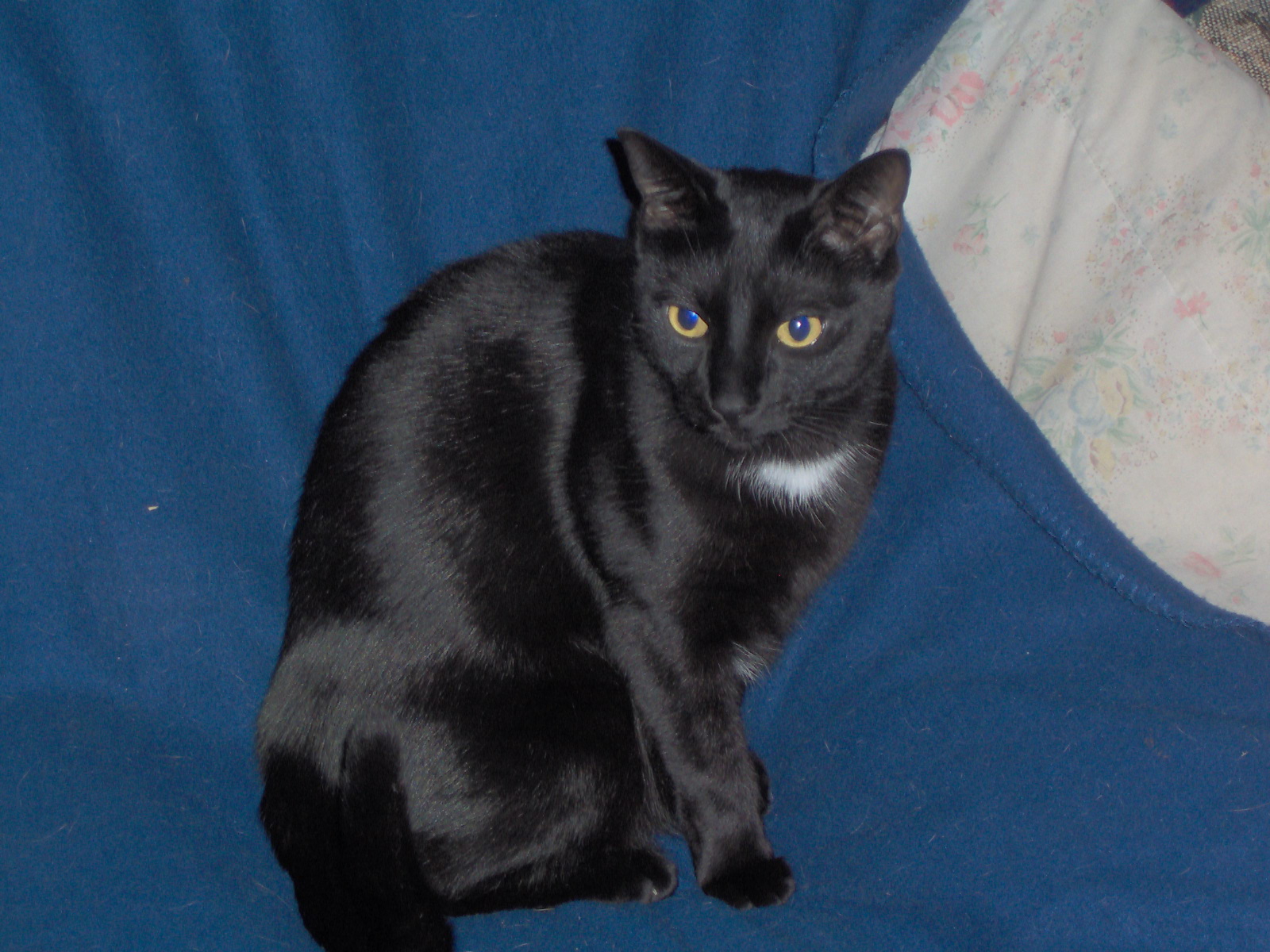
In the years we had Draco the Cat I found him perched on the tops of doors, curled up high on kitchen cabinet tops no cat should have been able to reach, and once found him asleep in the corner of a closet shelf he could not have gotten to without leaping over ten feet up straight from the floor. There was no place you could keep Draco in or out of. He was the Houdini of cats. There were three other cats who lived with us, all female: Little Kitty (a Sydney Greenstreet type of calculating villain), Eggnog (the perpetual damsel in distress) and Luna (the spacey hippie). Draco, as the male, considered himself a noble prince and Lord of the Realm but it was pretty clear that Little Kitty actually ran the show, using Nog and Luna as her puppets, and maybe this was why he felt he had to show his superiority in scaling heights and grand feats none of the others could attain. And maybe this was also how the war of the fish tank began.
As the fish swam happily around in their tank, always avoiding the Greek temple they were supposed to play in, the cats were watching. Once I passed by and, noticing the tank looked odd, paused for a closer look and found Luna sitting in back of it watching them. Another time Eggnog hopped up and tried to get her paw in the top to scoop one out. Little Kitty even hoisted her enormous bulk up onto the bureau where the tank sat to study the fish and contemplate their untimely demise. These were all singular incidents, however; it was only Draco who never gave up.
Draco didn’t care about the fish. In his world the fish were no more than wallpaper to his actual object of desire: the water. The fish tank pump continuously sent a cascade of water arcing down into the tank, making a soft, sibilant sound even when the tank was filled to the top; and Draco loved water. He loved the dog’s water. He loved the water in the kitchen sink. He loved the water left in glasses on the kitchen counters or living room tables. He loved all water everywhere in the house except the bathtub. All of these, though, were still waters; the fish tank was sparkling – and its soft sound beckoned.
The first time I found Draco drinking out of the fish tank I told him `no’ and put him on the floor. The second time I found him up there I yelled at him and tossed him onto the floor. The third time I discovered him I squirted him with a spritzer and shouted “No!” and the fourth time I did the same. The seventy-fifth time I repeated the above with variations. Nothing made any difference. My wife Betsy covered the opening of the tank with foil; Draco gently peeled it back and drank his fill. She covered it in plastic; he did the same. I covered it in plastic wrap, foil wrapped round with duct tape, and placed a large Styrofoam skull from Halloween on it to scare him off; he knocked the skull to the floor, broke through the plastic, and unwrapped the tank for a drink. At first, I just hadn’t wanted him bothering the fish, then I’d not wanted him drinking fish water. I also didn’t want him disturbing the pump’s operation – which he’d done twice. Finally, though, it became a simple battle of wills. Who was this cat to continuously defy me? I was the man, he was the cat, and he was going to learn to behave as it pleased me. Draco’s view of the situation differed; in his world, he was the cat and I was the thing he slept on and who was I to constantly annoy him at his water banquet?
The war of the fish tank dragged on for almost two years until its dramatic conclusion. My latest attempt to keep him off the bureau was to set up a number of pictures of the family in frames around the tank. I had also placed some figurines there, a desk calendar, a lamp. None of these deterred him. Lithe as a spirit, he would hop up and manage to land perfectly between my obstacles, raise himself up, and drink from the tank. I knew this first because I heard him jump down when I was sitting reading in the next room and he came in to sit on my lap fresh with the scent of fish tank upon him. I then saw him in action one time as I was coming down the stairs. His skill at landing in between the pictures and the figurines, not moving one of them an inch, was very impressive. Still, I could not let this cat defy me day after day and month on month. And so the day came when I walked into the room and there he was, draped over the top of the fish tank, absorbed in his drink. I grabbed up the spritzer bottle and let him have it. He reeled away from the tank, scattering everything around him. A picture frame flew to the floor with a loud crack, another disappeared in back of the bureau, the figurines spiraled skyward and all across the floor while the desk calendar danced itself in a pirouette and then joined them. Draco launched himself into the air and vanished into the other room.
I looked at the mess all over the floor and the cracked picture frame, thought of how I was going to have to now move the bureau out to retrieve the one fallen behind it, and realized he’d won. He had never been doing anything all that bad in the first place. Once I’d moved the pump further away from the side, he hadn’t bothered its operation anymore, he never disturbed the fish themselves and, since I always kept the tank clean, it wasn’t like he was drinking water which could harm him. The whole war, I realized, had been one sided with me as the aggressor. All Draco had wanted to do was enjoy his special water dispenser.
So he won. After that day I would sit writing at the computer, the fish tank trickling and bubbling beside me, and Draco would hop up, get his drink, and go on his way. The first time he did this after my surrender he watched me carefully with his large, round eyes, suspecting a trap. The second time he was also wary for any sudden moves on my part. The third time he was a little more easy, a bit more casual, but still kept raising his head to make sure I hadn’t moved and that the spritzer wasn’t in sight. By the seventy-fifth time he just ignored me and, after drinking, would sit by the tank while deciding his next move. He would then seem to shrug, gaze about a moment, and then hop down to go nap in his favorite corner of the living room couch.
I could have continued the war. I could have moved the fish tank, boxed the top, anchored the plastic or foil with hoops of steel; but what was the point? If you have a cat, you must at some point recognize who is master and who is not; and the sooner you do that the happier you both will be.
END
The White Dog (Previously published in Chicken Soup for the Soul Anthology)
I was standing out on the back porch the first time I saw him. I stood trembling, shaking, all through my body. My wife, Betsy, had been diagnosed with breast cancer less than a month earlier and, that morning, I would be taking her to the hospital for the procedure of the lumpectomy and removal of some lymph nodes.
A mug of coffee in my right hand, I’d just stepped out onto the back porch to take a few deep breaths and try to stop the panic I felt inside every time I thought about what we were going through. I could not stop my mind from asking the question I never wanted to think about – `What if she dies?’ – our daughter, Emily, was only two and a half at the time. We’d been married ten years then; felt like we’d known each other all our lives.
And so there I stood, trying to control the panic – when there he was, sitting out in the back yard near the east corner of the garage. He was a medium-sized white dog, a labrador mix maybe. I didn’t see him enter the yard from anywhere but I’d been distracted, lost in thought, wouldn’t have noticed him walking in from another yard on the street. The strange thing was, though, how he looked at me. He wasn’t moving, wasn’t sniffing the ground; he looked steadily at me with those warm brown eyes and I looked back and then he dipped his head slightly and walked off toward the tree line behind our garage.
It would have been absolutely nothing to speak of except that I felt, suddenly, much calmer. I was aware that I hadn’t felt this way since Betsy’s diagnosis a month earlier.
We’d only just moved into our house two months before and had been concentrating on fixing it up. I didn’t know the neighbors on the street, didn’t know who may have had a white Labrador or any other kind of dog. Certainly, I thought, the dog had to belong to someone even though it wore no collar. It was just a dog who had wandered into the backyard and nothing else.
I could not explain what I was feeling, though; how confident I suddenly felt that everything would be all right.
On the way to the hospital that morning I asked Betsy, “Do you believe in totems?”
“Maybe I would,” she said. “If I knew what one was.”
“Oh. You know, messengers from the spirit world, like angels, from God. Like as in Totem Poles, you know?”
“What messages do they bring?”
“Messages about our lives. Life, death, love, changes – hope – those sorts of things.”
“I guess God can send a message anyway he likes. Why?”
“Nothing. It’s just – I saw this white dog out back this morning and – and I just felt – better somehow. He was there and then he was gone but he – let me know it would all be all right. Everything with you. Sounds crazy, I know.”
She smiled at me and patted my leg.
The surgery was a success and, on this uneven path we found ourselves trying to walk steadily, the next step was chemotherapy. The only problem was that Betsy couldn’t take needles. The Oncologists decided the best way around this was to implant a sub-cutaneous port-a-cath in her chest to administer the chemo.
And so there came another morning of another surgery and, again, my stomach kept flipping around inside of me and my head felt light and tingling and I kept wanting to cry or hit something – and I stepped out onto the back porch with my coffee to see the white dog sitting in the exact same spot as before, looking directly at me.
I actually wanted to ask him a question. I wanted to ask him `Why?’ I wanted this dog to tell me why all of this was going on and how it would all end. The dog just sat there gazing at me and I felt instantly ashamed I’d forgotten the reassurance I’d been given before. No sooner did I remind myself of that than the dog turned and walked off in the same direction he’d gone earlier.
And the second surgery went just as fine as the first.
I went around the neighborhood asking people if they owned a white dog. There was one neighbor with a small white poodle – but that wasn’t `my’ dog. No one on the street over had a white dog matching `my’ dog either. As I’d drive around on my various errands or to work I became especially attentive to people walking dogs; but none of the dogs in the village was the white dog.
The morning of the first dose of Adriamycin I felt jagged and tired. Betsy hadn’t been sleeping well, worrying about how she would react to the chemo, and I had been up most of the night. Stepping out onto the back porch that morning I was silently praying the dog would be there; and he was.
In the same spot, with the same look in his eyes, the white dog gazed steadily across the short expanse of lawn at me and I looked back, sighed gratefully and nodded at him. He seemed to almost nod back but, I was sure, it was just that dip of the head he would do just before leaving. He started off in the same direction he always did, heading east toward the tree line.
I almost felt like crying in gratitude.
The feeling this dog gave me – that everything was going to be all right – was not a guarantee that Betsy would not die of cancer nor that we weren’t going to suffer; rather it seemed the assurance that, whatever happened, we were not going through it alone.
Betsy responded well to chemo and, when those treatments were done, she went through radiation. Months were measured in chemo treatments, trips to the Oncologists and diet regimens. We found ourselves closer than we’d even been before, we talked more, we took more chances, went more places, we had more fun. Nights in our house were like three kids at a sleepover as we’d play hide and seek with Emily or just dance to music in the kitchen, the three of us together.
And so a year passed and there came a morning when I was going to take Betsy to the hospital for another surgery: to have the port-a-cath removed. She was cancer free, at least for now; and I’d come to recognize that `for now’ is really all any of us have.
I half expected to see the white dog that morning as I stepped out onto the back porch; but then, I also knew, I didn’t need to. He’d already delivered the message three times and, finally, I’d understood it.
END
The Wonder of Our World
The dining room table was covered with small bottles of paint, different sizes of scissors, shards of cardboard. A retractable measuring tape lay bent across different sized hand-drawn blueprints covered in numbers and scales and drawings from assorted angles. We hovered over the table as the master architect, always a hands-on participant, directed the careful folding and gluing of the long and wide cardboard piece she and her daughter had been so carefully cutting and trimming and then there it stood amidst the mess – a small-scale wonder of the modern world – a perfect Egyptian pyramid. The architect, as precise as the ancient Imhotep, was my wife Betsy and her achievement that night in 1998 was all the more impressive as she was battling breast cancer and had just come home from another round of radiation treatment.
When our daughter, Emily, was three years old she fell in love with ancient Egypt. She had an Egyptian Barbie, dressed up as an Egyptian princess, spent hours with her Egyptian coloring book. This was not surprising since I had inherited a love for Egypt from my mother and taught classes on Egyptian mythology. Betsy and I had traveled through Egypt when we were younger. The bookshelves in the living room and study were thick with volumes on ancient Egypt. Small statues of gods, goddesses, Nefertiti, the Great Sphinx all gazed quietly down from shelves or pedestals and papyrus prints lined the hall leading upstairs. The most ironic aspect of all of this was that, although Betsy admired ancient Egypt, our first trip there was a little too memorable and she never mentioned it without making a face or rolling her eyes.
We were in our twenties, before Emily was born, when we visited Egypt. I was teaching for a university in Crete and we decided to catch a ferry over to Alexandria and spend a week roaming around. When we arrived, after everyone else had left the boat, we disembarked only to find ourselves surrounded by Egyptian soldiers who quickly hustled us across the tarmac of the port to a building where, obviously, nothing good awaited us. We managed to attract the attention of a clerk who spoke Egyptian Arabic, Greek, and English and was able to translate for the captain of the guard that we were just American tourists visiting from Greece; not the international drug dealers he’d assumed we were. Back on the boat, we decided to stay put and enjoy Alexandria from a distance but, really, who could do that? So we ventured out again only this time to find ourselves waylaid by a “guide” who led us to a small shop in a building off a side street where some other men made it clear we would not be leaving anytime soon. We got ourselves out of that one by way of a story that we had rich friends waiting for us at the boat who we’d love to go and bring back to the shop.

So, Egypt was off to a bumpy start but became a grand adventure. We gazed up at the Great Pyramid, the last of the Seven Wonders of the Ancient World, had drinks by the Sphinx, meandered down the Nile, traveled into the Sahara toward evening with the sunset glowing deeply purple below the dark horizon. I loved everything about Egypt but I knew it wasn’t the same experience for Betsy. She loved the experience of our being together there, appreciated the sights and culture but, as on so many occasions, she was only doing it all for me.
And so it was the night of the pyramid for Emily. Betsy had been diagnosed with breast cancer a few months earlier, had gone through surgery, chemo, and now radiation treatments. We had recently gone to see the film The Prince of Egypt and, ever since, Emily had been talking about how cool it would be to make a pyramid. Betsy did not hesitate for a minute but went right to work on drawings and calculations. When these were done, she found exactly the right kind of cardboard to work in – neither too thin, which might tear, nor too thick, which would be difficult to cut – and presented her blueprints and materials to us that night with her usual bright smile.
I was always worried about her during that time. I didn’t want her doing too much or exerting herself more than she needed to. She never seemed to worry about herself, though. I had always taken care of the housework and meals, she didn’t have to think about that, but she’d always been active on one project or another and was never much for just relaxing. My first thought that night was how making a two-foot high pyramid with an excited three-year old was maybe not just what my wife needed after radiation but Betsy wasn’t bowing to any such concerns. She waved away my suggestion that she rest and watch TV and pulled out the paints and other supplies for the great project.
We’ve always remembered that night and we still have the pyramid in the attic. Betsy was no more interested in having a two-foot high pyramid in the house than she would’ve wanted a large, rampaging gorilla but her daughter wanted one and that was all that mattered. I’m sure she would have liked to have rested on the couch and watched one of her shows but, as always, she put other people first and, in doing so, made memories.
The cardboard rectangle that night became a strange, lopsided shape and then, carefully folded and glued, slowly transformed into a pyramid. It rose from the center of the dining room table and Emily laughed and clapped her hands and we both gave her mom a round of applause. Betsy and Emily felt it looked rather bare, however, and so now came the painting. Emily said it had to look like a “real Egyptian thingy” so we all got out brushes and began painting Egyptian images like the ankh, an image of Bastet the cat goddess, wavy lines for water, standing lines for reeds, and then it all fell into silliness as Emily started painting whatever came to mind and we joined in. At the end of the evening there sat the craziest looking pyramid anyone had ever seen but Emily loved it and gave her mom a great big hug around the knees.
The radiation treatments passed and Betsy was cancer free and the years went on; but then the cancer returned again. She had to go through surgery and chemo and radiation and, again, Emily and I worried about her and cared for her as she had always cared for us. Betsy never quit, though, and she never once complained. She continued doing what she loved and what she loved was caring for us and making sure we were happy. Whether it was enduring Egypt for my sake or making a pyramid for Emily after treatments, Betsy was always there for us, for her family, her friends, and for anyone who needed a little help or a lot of joy in their lives. In one way or another, she was always making pyramids for people and, for all of us, she was a constant wonder in each of our worlds.
END
The Greatest Lesson Learned
I didn’t want to bring home a dog; it was the furthest thing from my mind. My previous dog was a great and gentle Doberman named Calhoun. For ten years we’d had adventures together and, after he died of cancer, I had no interest in replacing him. My daughter Emily had other plans, however, and that girl – who was only seven at the time – could be very persuasive.
And so it was that on a hot August day, when I still maintained I had no desire to bring home a dog, that I found myself with Emily and my wife Betsy driving to the animal shelter an hour away to look at some puppies. Betsy and Emily picked her out: a small white shy thing with large brown eyes and droopy ears, a lab-greyhound mix. We named her Sophia but she preferred `Sophie the Dog’ when called, or just `Dog’.
Emily gave us the speech every parent has heard concerning a dog: “I’ll keep it in my room and take care of it and walk it every day” but, since I worked from home mornings and taught classes only in the afternoons, that turned out to be my job from Day 1. I slept downstairs on the couch the first night, and many nights after, with Sophie nearby in her crate. She was scared and I took the soft, shaking pup out and let her sleep with me or put my finger through the crate’s grill to pet her until she slept. I was a goner by the end of the first night she was with us.

Soon, it seemed, she had always been a part of our family and I couldn’t remember what it had been like not having a dog in the house. I realized I hadn’t replaced Calhoun, I’d honored his memory in giving a good home to another dog who needed one; but that wasn’t the last or the largest lesson I learned from Sophie the Dog.
Two months after she came to live with us my mother was killed in a car accident. Ma and I were very close and I felt shattered by her death. In the mornings, after Betsy and Emily had left for work and school, instead of getting to my writing, all I could do was stare into space. I felt stunned by Ma’s death and that feeling seemed as though it was going to last the rest of my life.
Sophie, however, was not interested in watching me stare into space. She would nudge me to take her out and, once we were at the park, she would annoy me until I played with her. I’d trained her to walk off-leash and she’d run in circles around me, pick up a stick and drop it at my feet and, when I’d throw it for her to catch, she’d leap high in the air, snatch it and run back to smack me in the leg with the thing before running off again so I’d chase her.
She led me down forest paths I’d never explored and took me to ruins of old estates and silos in the woods I never knew were there. Some days we’d spend two hours out roaming and exploring the hiking trails around the village. When we came back home, she’d sit by my chair and put her head on my foot or rest it against my leg and it was so reassuring to feel her there, to be able to reach down and pet her soft head and see her look up at me with her dark, kind eyes. I learned from her that life goes on, no matter what kind of tragedy knocks you down, and that it can be good again even if it can never be the same.
That particular lesson I learned from her multiple times through many different events. When Betsy’s breast cancer returned and she had to go through surgery and chemo again, when Emily suddenly grew up overnight and didn’t want to hang out with her dad as much anymore, when any sorrow or uncertainty came my way – there was always Sophie the Dog with her bright eyes, wagging her tail, telling me it was time to get up and go out and see what life had to offer. And so we did; we played so much over the years, the four of us. Emily grew up with Sophie and so did Betsy and I in our own way.
When Emily was twenty and about to leave home, she decided she wanted a dog to bring with her who would be as close a companion as Sophie had been. She went to the shelter and came home with a little mini pinscher named Monty who Sophie took to almost immediately. I’d been worried that maybe Sophie the Dog would feel she was being replaced and would be resentful but I should have known better; Sophie always welcomed anyone we welcomed to the house. When Monty arrived, he was a little unsure of the situation. He wouldn’t bark at all and didn’t want to eat much but it wasn’t long before Sophie had shown him that everything was all right and he could feel at home and relax.
Monty was with us for four months before the time came for Emily to head out on her own and they moved to Georgia. It was another difficult time as Betsy and I experienced the `empty nest’ syndrome but Sophie was there for us just as she’d always been. She was older now, thirteen, and not as keen on racing around with a stick or leading me on adventures through the woods or old ruins – but she was there with all her grace and her warmth and charm and love. It was impossible to remain depressed with Sophie around and, at the same time, so hard to think about how sad it would someday be when she was gone.

And, when she left us finally, it was very difficult but I could only be grateful for the many years we’d had together. Sophie had come into our lives completely unexpectedly and filled them with light and love and with laughter and I knew, all along, that this would not last and I needed to always be thankful for the time we had and the adventures we all shared together. After a few months, I went back to the shelter and got another little puppy we named Sammie, a soft, brown Beagle-Feist mix, and she lit up our home with her antics just as Sophie had done sixteen years earlier.
Life is change, it is perpetual change, and we all hate losing what we love. But I learned from Sophie that life goes on and, no matter what knocks you down, you need to get back up knowing that it can be good again, can be beautiful, even if it can never be the same.
END
The following are “Betsy Ghost Stories” – accounts of her showing up after she’d slipped the body that was causing her so much trouble. My friend Angela once commented on this, saying, “Betsy seems so much more active now that she doesn’t have to deal with the cancer” and I think that is just the greatest line – and so true. There were plenty other episodes of Betsy showing up between 5 August and 7 November – the dates of the entries below – but these are the ones I shared with people on Facebook during that time. I’ve edited some of them slightly for clarity but I haven’t changed their content.

August 5 2018: Thanks, everyone. I am loving the love and support. I don’t want people thinking I was up all night in some lunatic state of grief. Emily and I actually returned to watching this absurd show we’ve been re-watching with Betsy lately – “Charmed” – must pause for shout out here to fellow “Charmed” watcher Angela Phillips – Yeah, can you believe it? – and went to sleep early.
But around 2:30 this morning I thought I heard her voice and woke up. She wasn’t on the couch and my first thought was that she’d gotten up on her own and was wandering around the house and I had this panic like “Where is she?” and started running around the place to find her. Then I suddenly felt very calm – like out of nowhere – just very calm – and felt like I heard her say “It’s all right. Go finish our story on Facebook and thank everyone” and so I did.
And these are the last words she said to me alone:
“I’m sorry I gotta go but I’ll see you and my sweet little kid again on the other side. I love you both.”
And she loved all of you. And we’ll all see her again. In the words of the hymn `Be Still, My Soul’ – “Be still, my soul. When change and tears are past/All safe and blessed, we shall meet at last.”
Thanks again. Blessings to all from the three of us.

August 5 2018: Now later: here is a fascinating experience I just shared with Emily, Krista, and Heather here.
Betsy Mark died yesterday, August 4th, at 4:54 pm. She was a great singer who communicated best through song and I see that death hasn’t changed that about her since she’s still at it. Here’s what just happened:
I was doing the dishes and put on this `Music Through the Years’ CD mix tape that Betsy made for us years ago. This is an anthology of tunes we have loved from 1980 up to the present on multiple CDs and the one I put on was one she always especially liked from 1990. So I’m listening to the songs and missing Betsy, but feeling grateful for all the time we had together, and then Monty the Dog – a supreme egomaniac of little patience – had to go out – so I hit pause and went outside with him.
When I came back in and hit `play’ I should have then heard the next song on the June 26 1990 CD which would have been the Lesley Philips’ tune ‘When Answers Don’t Come Easy’ but instead what came on was Bruce Springsteen’s `Back Streets’. I was confused and reached out to hit the forward button, thinking the CD was stuck, when I realized that `Back Streets’ isn’t on this CD. Betsy and I have always been huge Springsteen fans and the `Born to Run’ album has always been our favorite. When `Back Streets’ ended it was followed by `Born to Run’, which was followed by `Jungle land’ and then `Thunder Road’.
Here’s the wonderful and elevating thing:
First – two of those songs are not on that CD and the ones that are on there
are live versions – `Jungle Land’ isn’t on any of the `Music Through the Years’
CDs at all.
Second – those were Betsy’s four favorite songs on the `Born to Run’ album.
Third – Betsy used to sing `Thunder Road’ to our daughter Emily when she was an
infant and used to ask me to play the `Born to Run’ CD in that order so she
could end it by singing `Thunder Road’ to Emily and she would act out the
song in dance and song. `Thunder Road’ is also one of the first Springsteen
songs Betsy and I listened to together and had a special meaning for us both.
And, Fourth – when `Thunder Road’ ended, the machine stopped playing anything.
As noted, this is a multi-album-length CD with many, many songs on it and
something should have come on after the song ended. It works perfectly and I put in another CD to
test and it worked fine. And I then put the `Music Through the Years’ June 26
1990 CD back in and it played as expected. I was amazed. When the songs were
playing, Emily and her two friends Heather and Krista were in the next room and
I said “You’ve got to hear what’s happening in here” and Emily said,
“Springsteen’s not our thing” and I said, “No, you don’t understand. I’m not
playing these songs. She is.” They were suitably freaked out.
So – I take this to mean Betsy got to the other side safe and sound and is sending us confirmation as in “All good! I’m here and I’m safe and it’s all right!” And that’s just the sort of thing she would do and just the way she would do it.
Magnificent. Well Played, my friend, well played.
Further, when I tried to replace the “potty seat riser” I could not do it. It had been somehow compromised so the screw on the left side would not work. I sent Emily and Krista out yesterday to pick up a new toilet seat but had not had a chance to put it on. So I am interpreting this experience of putting on a toilet seat at 1:00 am to Betsy further encouraging us to let go and, I don’t know, all put on our own respective toilet seats and enjoy the hell out of them.
I know. This is a very painful time for all who have known and lost her – but here’s the thing: you have not lost her as long as you retain gratitude for having known her because then you can draw true joy and healing and elevation from that. If you’re just mourning what’s been lost, and are clinging to the past, you’re not doing yourself any favor and you are NOT honoring the life of the person you are claiming to have loved. She would not want that.
We don’t have to “move on” or accept what has happened easily – but we can be grateful for what we had and honor what was lost with gratitude and grace and love. I am breathing deep and breathing deep and raising my arms to the sky and having a few beers and taking a few drams of my old friend Seagram’s 7 when I need to but I am not going to regret anything of our time together. Not even the end. It was all beautiful. And it should not be lost in grief. No matter how tempting that route is. No way to avoid the chest-wrenching pain and the tears, I know that, but don’t stay there and call it home.

August 13 2018: Earlier in life, when I posted the bizarre night of the Springsteen songs playing which should not have been playing, people posted about songs they’d heard which they either shouldn’t have heard or which had meaning for the person recently lost. I had to run a number of errands today and the first was to Home Depot for some solid soil for the Dogwood tree and this song – “We May Never Pass This Way Again” by Seals & Crofts – was the song that came on as soon as I walked in the door. The significance is that this is the – THE – first song Betsy ever played for me in 1980. It was her favorite song then and she always loved it and wanted it included on mixed tapes. I walked into Home Depot, heard it, laughed, and raised my arms and said, “Thank you.”
It wasn’t there this morning or this afternoon when I ran around shutting the windows against the rain and neither of us have seen it in years. We both remember her wearing it in Maine in 2007 when she got her back piece of the mermaid to go with her dolphins but don’t remember it after that and Betsy herself didn’t know what had happened to it and figured it was lost.
Wherever it went, though, it was found today and appeared perfectly spread out like a gift on Emily’s nightstand. THANK YOU, BETSY!
August 15 2018: SO – another fascinating experience. The dining room table we have here is the same one Betsy picked up at a St. James’ yard sale with her mom and dad the summer of 1987 just before we got married. She’s always liked its look and she’s never wanted it covered with any kind of cloth except at Thanksgiving and Christmas.
I was cleaning up and getting rid of some clothes and tapestries of Emily’s that she didn’t want anymore and, just to put this one large wall piece somewhere while I sorted in the dining room, I covered the table with it. Then I sort of liked it. It was bright blue with an ocean/fish motif going on and it pulled in the colors of the wallpaper. So I put our wooden napkin holder in the center and straightened it out and it looked pretty nice. And on I went with the cleaning.
A little later, Emily and I were on the back porch when we hear a clatter from the dining room and go in to find the tapestry on the floor with the wooden napkin holder. No breeze, no wind, no open window, no cat running from the room, no reasonable or logical explanation for it other than Betsy never wanted the table covered with a cloth and she’s not about to stand for it happening now.
Can’t say I wasn’t warned. Eric Bernholc told me I’d better stick to her list or she wouldn’t be happy and I should’ve known better. It’s quite interesting. Years ago, I wrote a story about a guy who lives with the ghost of his wife but I never thought I’d someday be living it.
August 18 2018: The latest fascinating experience:
I wrote to Mike Whitman yesterday about doing some work around the place here that Betsy wanted done and he suggested this morning that I contact Kurt Hues for the job. I didn’t have Kurt’s contact info and wasn’t sure if Betsy wanted him for the job and went about various tasks here while thinking about it.
I was doing the dishes when I heard distinctly in my head “Look in email March 30th”. So I did and there was an email from Kurt Hues giving us an estimate on this very job. I’d totally forgotten Betsy Mark had him here to give an estimate months ago and wanted him for the work and I wouldn’t have thought of him on my own.
So thanks Mike Whitman for the suggestion. And thank you, Betsy.
September 3 2018: Fascinating experience early this morning which I’ve been going back and forth on sharing here and don’t know why. Unlike other experiences recently, I don’t have a clear “go ahead” feeling on sharing but, at the same time, I think the experience is pretty cool and people could draw something from it.
I woke at 2:30-something feeling a presence in the room. I whispered, asking if it was Betsy, because I wasn’t sure. It was a very gentle presence. Elevating. I don’t think I asked for a sign – just was asking if it was her in the room. I didn’t get any answer and everything was silent in the dark room and I just continued to feel this presence.
Then
Sammie the Dog, who was sleeping next to me, woke up and leaped off onto the
floor the way she does when she greets people and started running around and,
at the same time, the TV went on by itself. Now I could say that maybe I hit
the remote when I sat up as Sammie went racing around but the remote was maybe
two feet away from me on top of Sammie’s crate.
Then I saw it was 2:38 am and realized that today is September 3rd. It was
exactly one month ago, August 3rd, at 2:38 am, that Betsy told me her
dream-vision of the afterlife and how much she wanted to go.
The gentle presence seemed to fill the room. Sammie was still running around and then added her own special touch to the moment by throwing up on her floor pillow the way she sometimes will when overly-excited, as she’d get sometimes when Betsy came home from work. And I felt strangely elevated and light and comfortably warm as though the room was another room or in another place and I was hovering just over the covers and then it was like a switch turned off and everything returned to normal. Then I noticed the TV was weird, the channel I was on was not the channel it should’ve been and the programming on the TV was completely off, changed, nothing like it should have been.
This experience comes after a weekend of small incidents like objects being moved around on the glass shelves in the foyer and getting the feeling I should move her large photo from the service to another spot which made no sense to me.
4 November 2018: I’ve meant to share some Betsy stories but have been held up on two counts: 1 – and most importantly – I haven’t wanted to pull anyone backwards into the past. One can’t progress forward if one is always being pulled back to a point in the past. 2 – I’ve finally gotten back to writing for Ancient History Encyclopedia and it takes a lot of time for me now to construct each piece, much more than it used to, because I’m missing my muse.
But I was out back today talking to Janeen Samuels Martin and Bill and they asked me about Betsy Mark and I was telling them of her recent antics and realized I really should share them with others – and I hope they make you smile and don’t take you down backwards to a dark place – but I also got a message from the woman herself this morning which I have to share because it’s just, well, not only what she asked me to do but also so sweet and lovely.
She’s been pretty active around the place – and please let me know if she’s visited you at any time. There have been a number of episodes from moving pictures in the foyer to removing a mop head, to – just today – taking said mop-head out of the washer and putting it on top of the dryer I’d just cleared and cleaned off, to changing songs on the Music Through the Years CD. On Halloween day in the afternoon she switched the compilation CD from June 26 1990 to June 26 1991 and played one of her favorite songs – and one of the first songs we ever sang together in 1980 – `I’ve Loved These Days’ by Billy Joel.
But here’s my favorite recent antic and the one she wants me to share with you:
I have not been able to remember my dreams since she left. I always remember my dreams and I always dream in narrative form – my dreams always, or almost always, have a beginning, middle, and end – and I always remember them and I would write them down and send them to Betsy the next day in email or, in the old days, in letters.
Halloween night I had this dream where I was in a large building, many halls and many rooms, and I felt lost but also that I had to keep moving in a certain direction. After a while I came to a door and pushed it open and found myself in a concert hall and there were assorted people sitting in chairs and I knew they were waiting to audition for a part in a show.
And then I saw Betsy Mark and she looked up and smiled brightly at me like she was so glad I’d come and she waved. She looked so happy. And then I woke up.
Early this morning I had the same dream but, this time, after she waved, she jumped up and hurried toward me, hugged me, and said, “Tell everyone I’m okay, all right? Tell everyone I’m fine. I’m fine. And I love you all. And I’ll see you again. Okay? Okay. Thanks for the numbered days.”
And then I woke up. And the room seemed filled with soft light even though there were no lights on.
The “Okay? Okay” comes from John Green’s `Fault in Our Stars’ and was one of her favorite lines – she painted it on the wall of our garage – along with the line, “You gave me a forever in the numbered days and I am grateful” – which she also painted on the inner wall of the garage. So, on the third-month anniversary of her departure, she says hello and wants you all to know she’s fine – and she’s grateful.
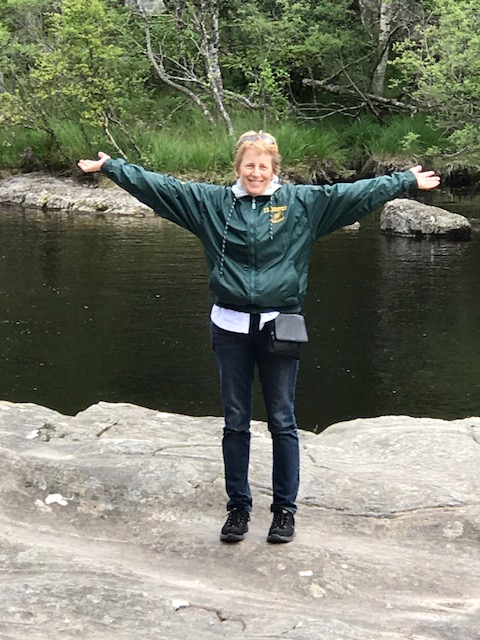
7 November 2018: So interesting. We never know what’s coming next around here these days. Here’s the latest story:
This was a really productive and great day. I wrote a comprehensive history piece on the Kingdom of West Francia, gave an interview to a woman from Science Friday on cats in the ancient world and, besides that, it wasn’t raining for once.
But, as I know many of you know, when you have a great day after a loss and you’re feeling pretty fine, there’s that draw of emotional gravity that pulls you straight down. I’m fine as long as I’m writing in a day but, as soon as I’m out of the piece, I’m back to missing Betsy Mark and today, around 4:30, I was hit with the memory trip of how, once upon a time, she’d be coming home from work soon and we’d talk about the day while I made dinner and I’d tell her all about West Francia and the interview – and I started feeling pretty sad and then started feeling worse.
So I decided to start dinner and hit the play button on the kitchen stereo to listen to the Music Through the Years compilation CD I was listening to the other night. Instead of the song which was supposed to play, Lana del Rey’s `Change’ started playing. That CD was not the one in the machine from the other night and I haven’t changed it. I grabbed up the CD case for Music Through the Years and it was in there. I then dug down under and picked up the Lana CD case and it wasn’t in there. I then realized I was wasting my time acting like a jerk trying to figure out what was happening and just listened to the song and loved it as always. This song is THE theme song of the latter part of the cancer journey with her. I used to have to listen to it at least once a day to keep from losing it from May through August and then from August until October.
On the Lana CD, `Change’ is number 15 – not number 1 – if I’d somehow put the CD in there after Sunday night it would’ve started at 1 – but it didn’t – it started at 15 and, when the song ended, the CD stopped. It didn’t go on to 16.
It was so great. It was really so great. I felt like she was saying, “You don’t have to feel sad. I know all about what you did with West Francia and the interview and it’s all fine and here’s that song about change that meant so much to you and still does and, see? The song is true. The song is true. It’s all all right.”
I didn’t feel sad after that. I started laughing. Sure, I’ve done plenty of crying since she left and I miss her every day but it’s harder to miss someone when they’re constantly popping in to say hello and reassure. I love how, typically, she keeps communicating with us all through music.
END
 Joshua J. Mark